Dust Mite Guide › What Do Dust Mites Look Like?
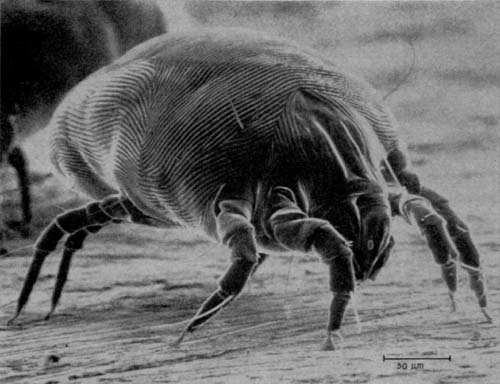
Dust mites are too small to see without magnification.[3] Under a microscope, an adult house dust mite is a tiny, pale (transparent) creature with eight legs, about a quarter to a third of a millimetre long.[1] Here’s what they look like up close, why you won’t spot them on your mattress, and what to look for instead.
Not medical advice. This page is for education only. If you think dust mites are affecting your health, see a doctor or allergist.
Dust mites are arachnids, the same broad group of arthropods as spiders, not insects.[2][4] They are too small to be seen without a microscope or magnifying glass.[4][3] A scientific review of their biology describes house dust mites as practically invisible to the naked eye.[2]
An adult house dust mite is about 0.25 to 0.33 mm long.[1] Across house dust mite species and life stages, a review gives a range of roughly 0.1 to 0.4 mm.[2] Their droppings (fecal pellets), which carry much of the allergen, are far smaller still, about 10 to 20 micrometres (0.01 to 0.02 mm).[2]
No. Because dust mites are too small to see,[3] you can’t identify them, or their droppings, by looking at your bedding or furniture. Anything you can see with the naked eye isn’t an identifiable dust mite. A home doesn’t need to look dirty to have a dust mite problem.[4]
Dust mites live in bedding, mattresses, upholstered furniture, carpets and curtains. These places collect skin flakes from people and pets, which are their main food, and dust mites thrive in warm, humid settings.[3] Because people spend many hours in bed, most exposure to dust mite allergen happens while sleeping.[3] See How to Get Rid of Dust Mites in a Mattress.
Instead of looking for the mites, pay attention to symptoms. Dust mite allergy can cause sneezing, a runny or stuffy nose, red, itchy or teary eyes, and in some people wheezing, coughing or chest tightness.[4] An allergist can find out what you are reacting to, often with a skin test and sometimes a blood test.[4] See Dust Mite Allergy Symptoms.
They aren’t insects; they’re arachnids.[2] And they don’t bite: they are not parasites that bite, sting or burrow into the body. People react to breathing in proteins from mite droppings and decaying mite bodies.[3] For more, see What Are Dust Mites? and Do Dust Mites Bite?
No. Dust mites are too small to see without magnification.[3]
An adult house dust mite is about 0.25 to 0.33 mm long. A scientific review gives a wider range of about 0.1 to 0.4 mm across house dust mites.[1][2]
Adult house dust mites are described as transparent, so under a microscope they look pale.[1]
No. Dust mites don’t have eyes; they sense their surroundings with special receptors, including ones that detect scent signals from other mites.[2]
You can’t tell by looking. Dust mites are too small to see without magnification, so anything you can see with the naked eye isn’t an identifiable dust mite. If you think dust mites are affecting your health, a doctor or allergist can test for a dust mite allergy.[3][4]
Get the free, practical plan: Read the Dust Mite Guide →
This page is for education only and is not medical advice. See a doctor or allergist for testing and treatment. This page does not recommend specific brands or products.